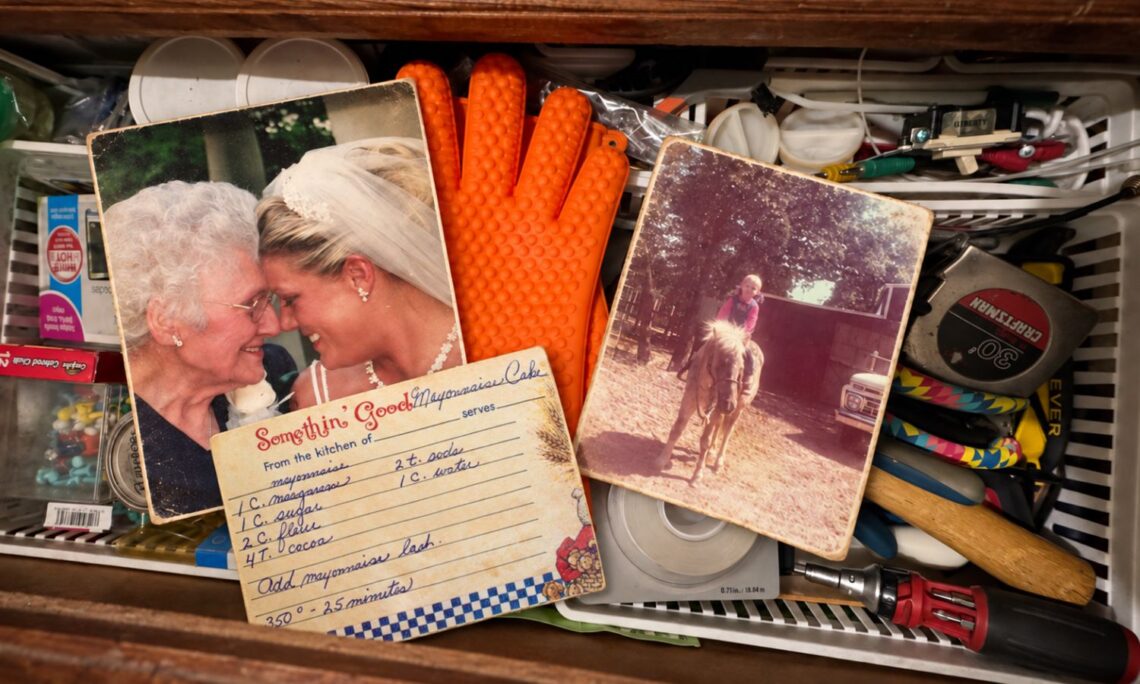
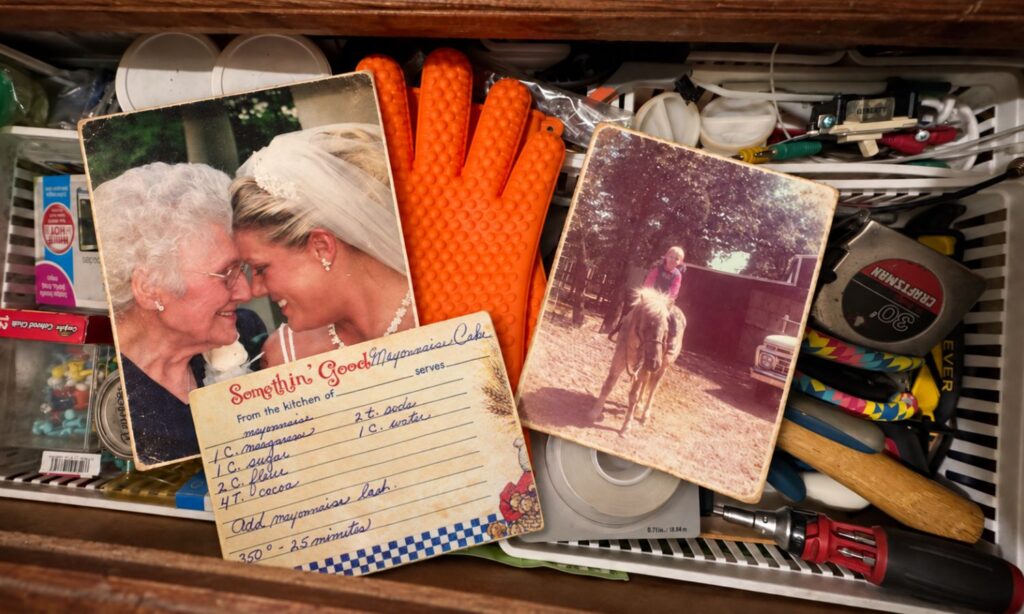
We all have a drawer like this—the place where “just in case” goes to live.
And if we’re being honest, it usually doesn’t stop with one drawer.
It spills into closets, cabinets, garages, spare bedrooms, attics, barns, and every other place with a door we can close. Before long, useful things are mixed together with forgotten things, inherited things, sentimental things, and things we keep for no reason other than the fact that we have had them a long time.
Just in case we need that extra cord.
Just in case someone can use those old sheets.
Just in case that container finally finds the lid it belongs to.
Just in case we need seven travel mugs, four serving platters, the appliance we haven’t touched in six years, or the box of things we inherited and still haven’t opened.
But how often does just in case really come?
The harder decisions begin when the things we are keeping have a person attached to them.
We may not need the thing at all.
We keep it because it belonged to someone we loved.
A recipe card in familiar handwriting.
An old photograph.
A kitchen tool.
A Bible.
A dish that always sat in the middle of the holiday table.
A little piece of someone’s life that found its way into ours.
And if we’re not careful, we begin to believe that letting go of the object means letting go of the memory.
But it doesn’t.
The thing is not the memory.
We Are Not Our Stuff
There is nothing wrong with having things.
Useful things make a home function. Beautiful things make it feel personal. Old things can connect us to people and places we love.
This is not an argument for empty rooms, bare shelves, or getting rid of everything that does not serve an obvious practical purpose.
I love things with history.
I love handwriting that is instantly recognizable.
I love furniture that has been passed down.
I love a dish that has appeared at the same family table for decades.
I love the little imperfections that tell you something has actually been used and loved.
But there is an important difference between loving an object because of the story it carries and feeling responsible for every object that ever belonged to someone we loved.
There are things we keep because looking at them genuinely brings that person close.
And there are other things we keep because letting them go feels wrong.
Almost disloyal.
As though getting rid of the sweater, the bowl, the old tool, or the box of miscellaneous belongings somehow says the person mattered less.
But it does not.
Your grandmother is not in the bowl.
Your mother is not in the sweater.
Your father is not in the tool.
The people we love are so much more than anything they owned.
What remains with us is the life we shared with them.
The stories we know by heart.
The things they taught us.
The expressions we still catch ourselves using.
The recipes we make without looking at the directions anymore.
The values they passed down, whether they ever realized they were doing it or not.
An object may help bring all of that back.
That can make it precious.
But the object does not have to carry the entire weight of the relationship.
And recognizing that gives us permission to decide more carefully which things truly deserve to stay.
Because keeping everything is not the same thing as preserving what matters.
We Inherit More Than Things
A few years ago, I was taking clothes out of the dryer while my husband stood nearby talking to me. I pulled out a pair of his work jeans and did what I have done to jeans for as long as I can remember.
I straightened the legs.
Lined up the seams.
Matched the hems.
Then I folded the jeans over in the middle and smacked the denim against the front of my legs twice.
Not once.
Twice.
My husband stopped me.
“What does that do?”
I had no idea what he was talking about.
“What does what do?”
“That. Smacking the jeans against your legs.”
And without even thinking about it, I told him:
“I don’t know. Mimi always did it.”
That was my entire explanation.
I had watched my Mimi do it when I was young, and apparently I decided somewhere in my little brain that this was simply an important part of folding jeans.
I still cannot tell you what those two smacks are supposed to accomplish.
I cannot tell you why Mimi did it.
Maybe she had a reason. Maybe it straightened something. Maybe it knocked out a wrinkle. Maybe she once watched her own mother do it.
Or maybe there was never a reason at all.
But I can tell you this:
Every pair of jeans that comes out of my dryer still gets those two smacks.
That little habit makes me smile now because it reminds me how much of a family gets passed down without anyone ever sitting us down and saying, This is something I want you to remember.
We inherit gestures.
Routines.
Ways of cooking.
Ways of folding laundry.
Things we say without realizing where the phrase came from.
Holiday traditions.
Household habits.
Little methods that feel completely normal until somebody standing beside us asks:
“Why do you do that?”
And suddenly the only answer we have is:
“Because that’s how she did it.”
Some of those things are worth keeping for no reason more complicated than the fact that they make us remember.
I don’t need those two smacks to make the jeans fold correctly.
But every time I do it, there is a tiny piece of Mimi standing at the dryer with me.
That is legacy too.
And it is an important reminder that we do not have to keep everything a person owned in order to carry pieces of them forward.
Sometimes what remains isn’t an object at all.
Sometimes it is the way you fold a pair of jeans.
Legacy Should Be Chosen, Not Accumulated
That may be the distinction that matters most.
Legacy is not everything we leave behind.
Legacy is what we intentionally choose to carry forward.
That old serving platter may deserve a place in your home because it appeared on every Thanksgiving table you remember and you still use it every year.
That is different from keeping twelve other platters because they are technically still good.
One carries a story.
The others may simply occupy a shelf.
Not every possession has to become a serious decision.
Sometimes a bowl is just a bowl.
Sometimes a lamp is just a lamp.
Sometimes an old sweater has simply finished its work.
And that is perfectly fine.
But when something does matter, we should know why.
That is where the next question becomes useful:
What are we actually keeping?
Before You Keep It, Ask What You Are Actually Keeping
When you come across something old, inherited, sentimental, or difficult to part with, it may help to ask something other than:
Could I use this someday?
Ask yourself what you are actually holding on to.
Whose was it?
Do I know its story?
Would someone in the next generation understand why it mattered?
Do I love the object itself, or do I feel guilty getting rid of it?
Is the memory tied to this particular object, or would the memory remain even if the object did not?
Would I choose this item for my home today if there were no family connection?
And perhaps most importantly:
Is this something I intentionally want to carry forward?
There is no universal right answer.
One person may treasure her grandmother’s mixing bowl because she spent every Saturday morning standing beside her making biscuits.
Another person may inherit a nearly identical bowl and feel absolutely nothing when she looks at it.
Neither person is wrong.
Sentimental value cannot be assigned from the outside.
Keep the Story With the Thing
One of the saddest things about inherited belongings is how quickly their stories disappear.
We know something belonged to Grandma.
But which grandma?
We know a photograph is old.
But who is standing in it?
We know a dish came out every Christmas.
But why that particular dish?
One generation knows the whole story.
The next remembers part of it.
And before long, something meaningful becomes simply “an old thing from the family.”
If something matters enough to keep, preserve its story along with it.
Write a note.
Label the back of the photograph.
Slip a card inside the box.
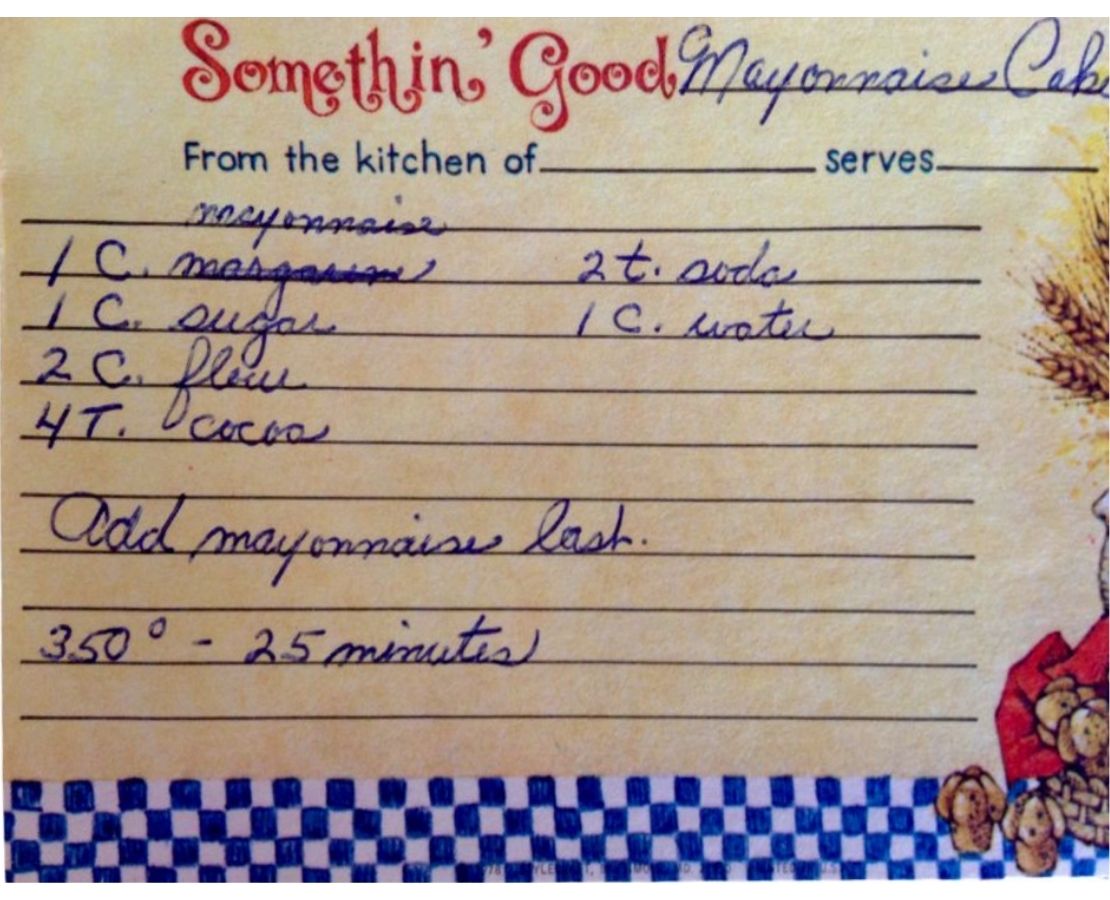
Record whose handwriting appears on the recipe.
Write down where the piece came from and why your family remembers it.
Tell the story while there is still someone available to tell it.
Because often the most valuable thing attached to a family heirloom is not the object itself.
It is the information nobody thought to write down.
Preserve the Ordinary Things That Carry a Voice
We tend to think of heirlooms as fine china, jewelry, antique furniture, or things with obvious monetary value.
But some of the most meaningful things families possess are much quieter.
Handwriting.
Notes in cookbook margins.
A stained recipe card.
A letter.
A farm ledger.
A handwritten prayer.
A Bible with underlined verses.
A note tucked into a lunchbox years ago.
These things allow someone we love to remain recognizable.
You can see how she made her capital letters.
You can see where he crossed something out.
You can see the shorthand only the family understood.
Those imperfections are often the very things worth preserving.
Not because everything old must be saved.
But because occasionally an ordinary piece of paper carries something an expensive object cannot:
a person’s voice.
It is Okay to Let Some Things Finish Their Work
Something can have been useful, loved, and important without needing to remain in the family forever.
A piece can finish its work.
A tradition can finish its work.
A household method can finish its work.
That does not make any of it meaningless.
It simply means it served the season for which it was needed.
There is a kind of gratitude in being able to say:
This served our family well. We do not need to carry it any farther.
We do not dishonor previous generations by making thoughtful choices about the lives we are living now.
They made practical decisions for their homes, their families, their budgets, and their circumstances.
We are allowed to do the same.
And releasing the things that no longer matter can create room to care properly for the things that do.
Keeping Less Can Help Us Preserve More
If a handwritten family recipe is buried beneath boxes of miscellaneous papers, it is technically being kept.
But is it being preserved?
If important photographs are mixed into bins with thousands of unidentified prints, are we really protecting the family story?
If an heirloom is shoved into the back of a closet because there is no room for it among everything else, are we honoring it simply because we never got rid of it?
Keeping less is not necessarily a rejection of family history.
It may be exactly what allows us to see it.
When some of the noise is reduced, the meaningful pieces become easier to recognize.
We can display them.
Use them.
Protect them.
Write down their stories.
Share them with our children and grandchildren.
Let them participate in family life again instead of spending another generation packed inside a box.
The Goal Is Not to Leave Behind More
One day, whether we like to think about it or not, someone else may have to sort through the things we leave behind.
I do not want that person to wonder whether every object in every drawer carries enormous sentimental importance.
I would rather make the distinction myself.
I want the things that matter to be recognizable.
I want the stories attached to them.
I want the next generation to know why something was kept.
And I want them to know they are not required to keep it forever simply because I did.
Perhaps the best legacy we can leave is not a house packed with evidence that we lived.
Perhaps it is a smaller collection of things that help tell how we lived, what we valued, whom we loved, and what we believed was worth carrying forward.
That is very different.
Making Room for What Matters
This is where all of this is about to become very real in our own home.
My Mimi and Pappy bought this house in 1959.
My dad lived here from about the sixth grade on. I spent my childhood here. I learned to ride my bike on this street.
Then in 2009, my husband and I had the opportunity to buy the house from my grandmother, and we decided it was the right thing to do.
And now my grandson has learned to ride his bike on this same street.
I have never really known a life where this house was not involved, somehow or some way.
So when I talk about clearing the slate, I do not mean pretending the past was never here.
The past is part of this house.
The challenge is learning how to honor that history without asking every object, every room, and every old way of doing things to remain exactly as it has always been.
We are preparing to move our home office into another room and give the space a much-needed cosmetic upgrade.
There will eventually be fresh paint, a better layout, improved filing and storage, and a room that works better for the way we actually live and work.
But before any of that happens, there is a more important job to do.
We have to decide what comes with us.
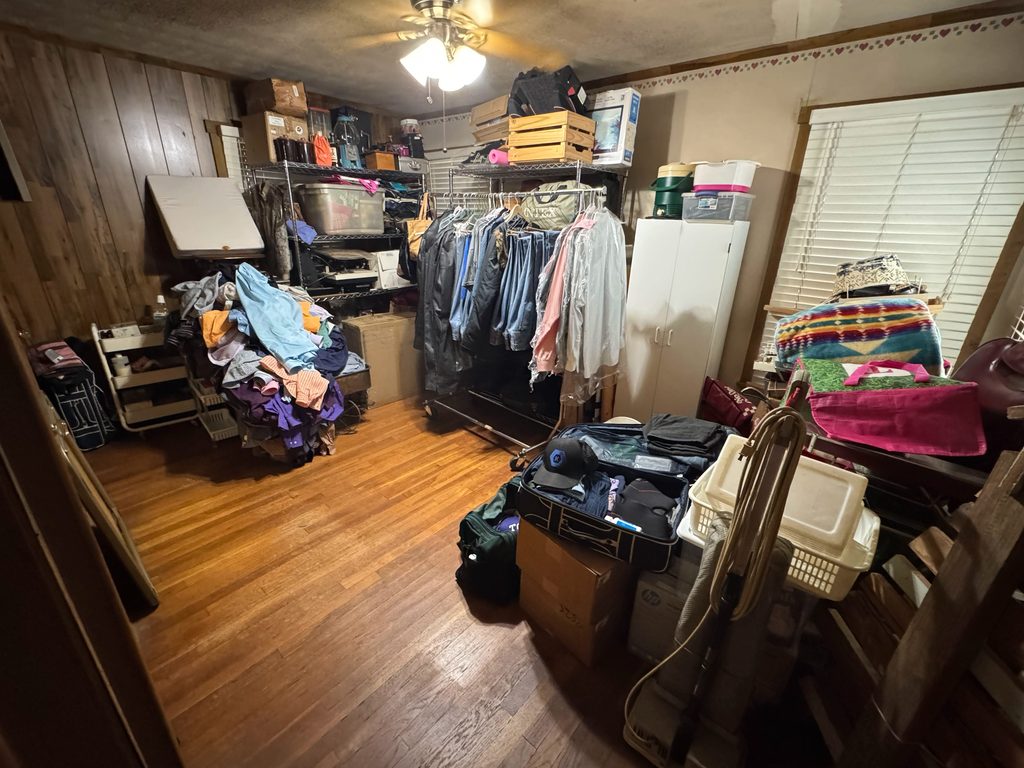
The room you see here is not staged for a dramatic before-and-after.
I did not pull things out of closets or scatter boxes around to make the transformation look more impressive later.
This is simply how it looks right now.
It has become a landing place for clothing, equipment, boxes, things waiting for a permanent home, things we still use, things we haven’t used in years and, as you can probably guess, quite a few things being kept just in case.
I do not want to move years of accumulated things from one room into another and call it organized.
But I also do not want the things that genuinely carry our family story to disappear simply because we are starting fresh.
So I am beginning a new series here at Cedar & Linen:
Making Room for What Matters
Preserving Legacy While Clearing the Slate
I’ll show you the room as it really is, the decisions we make, what stays, what goes, the systems that work, the ones that do not, and eventually the room that emerges on the other side.
The rule for the new office is simple:
If it does not have a permanent home, it does not get to move into the new room.
I have a feeling that rule is going to be considerably easier to say than it is to follow.
But that is part of the point.
Clearing the slate does not have to mean erasing the past.
It can mean giving what truly matters enough room to be seen.
Keeping the Story
Keep the handwritten recipe because seeing those familiar loops and flourishes makes someone you love feel close again.
Keep the photograph—and write the names on the back.
Keep the Bible with the notes in the margins.
Keep the platter if Thanksgiving would not feel quite right without it.
Keep the chair your father built if you still smile every time you walk past it.
Keep the tradition whose meaning still matters.
Keep the lesson that still holds true.
Keep the two little smacks against the front of your legs every time you fold a pair of jeans, even though you still have no idea what they are supposed to accomplish.
Keep the story.
But give yourself permission to release the rest.
We are not our stuff.
The people we love were never their stuff either.
The memory does not disappear because the tangible thing is gone.
What they gave us is carried in far more enduring places—in our hearts, our stories, our habits, our faith, our traditions, and the countless little ways their lives continue to shape our own.
What deserves to become legacy is not everything that survived long enough to reach us.
It is what we recognize, understand, and intentionally choose to carry forward.
And perhaps that is one of the kindest forms of stewardship we can practice:
remembering well without keeping everything.
A Scripture to Carry With You
“We will not hide them from their children, but we will tell to the generation to come the praiseworthy deeds of the Lord, and His might, and the wonderful works that He has performed.”
Psalm 78:4 — AMPC – https://www.bible.com/bible/8/PSA.78.4.AMPC
The heart of legacy has never been the amount of stuff we can preserve.
It is making sure the next generation knows the story.
Look what the Lord has done.
Scripture quotations taken from the Amplified® Bible Classic (AMPC), Copyright © 1954, 1958, 1962, 1964, 1965, 1987 by The Lockman Foundation. Used by permission.
